
Early Childhood
Ages 2.9-5
“We cannot prepare [children] for entering a new age by teaching them only about this one. Rather, we must prepare students by nourishing in them capacities that can serve them in unimaginable situations of the future.”
– Roberto Trostli, Rhythms of Learning

We are dedicated to preserving childhood by providing young children with ample time for free, open-ended play, and cultivating a learning environment steeped in beauty and warmth. Authentic human connection is the cornerstone of our early childhood program: our educators meet each individual child at their unique developmental phase, facilitate child-led, imaginative play, and surround children with rich, natural imagery through seasonal songs, verses, stories, and crafts.
Our educators work to hold space for the rhythmic flow of energies throughout each day. Our daily rhythm reflects careful attention to what Waldorf educators refer to as “in-breaths” and “out-breaths”: periods of open-ended, imaginative play and lots of gross motor movement punctuated with periods of quieter, more focused, and fine motor activities.
Imaginative Play
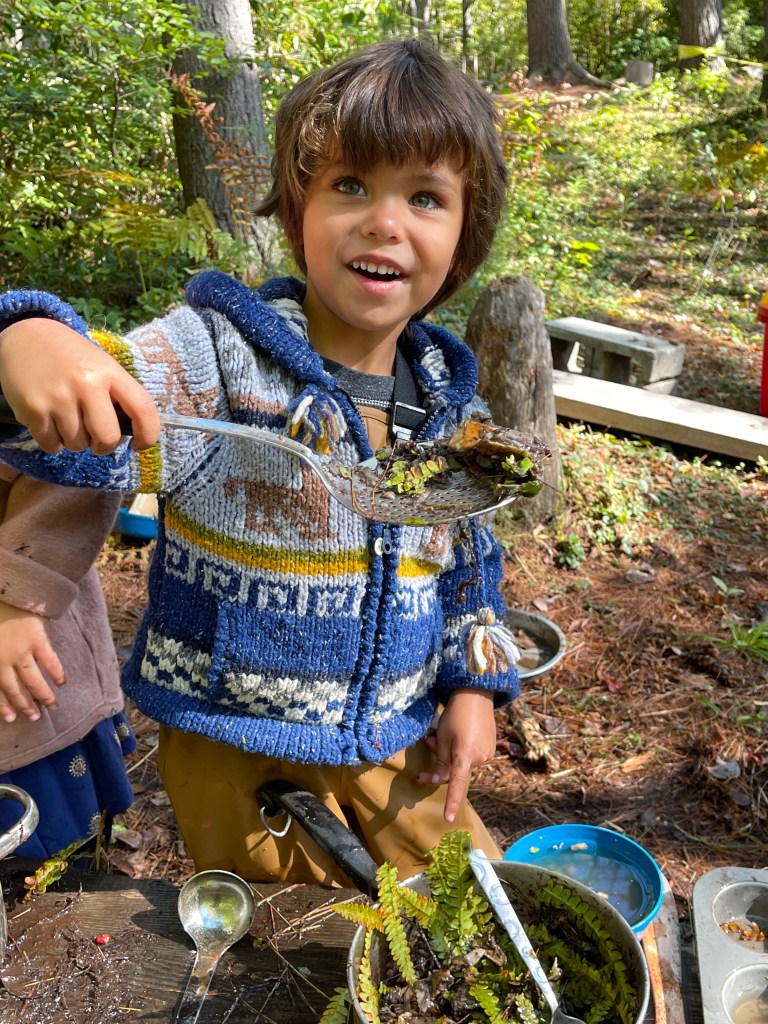
During play time, our educators work as the banks to a river: holding space for wide-ranging, child-led, imaginative play while remaining aware and present, available to assist children when needed. The forest classroom provides a particularly inviting setting for imaginative play, morphing from mud kitchen restaurant to pirate ship harbor to gnome village in the space of a single day.
Pre-Literacy
In the early childhood program, our educators work to cultivate pre-literacy skills through singing, sharing stories, and reciting verses. These stories, songs, and verses often become the inspiration for the children’s play. We aim to immerse children in a world of rich imagery by which they can appreciate the connections that exist between themselves, their communities, and their natural environment.
Creative Arts
We believe in the value of the creative arts not only as a means of expression but as a methodology for learning. Children in our program are invited to work with natural materials like clay, wood, and other found objects in honing their fine motor skills alongside their creative energies. Children utilize found, natural materials in creative ways and build confidence in their own artistic abilities.
 Hemlock Hollow Homeschool Community